Generating articulated 3D objects, from everyday tools like pliers and eyeglasses to robotic arms and quadrupeds, requires modeling both geometric diversity and kinematic constraints — a challenge that existing point-cloud generators ignore and prior articulated methods address by assuming predefined kinematic skeletons. We propose ArticFlow, a flow-matching framework that learns a controllable velocity field from noise to target point sets under explicit action control. ArticFlow couples (i) a latent flow that transports noise to a shape-prior code and (ii) a point flow that transports points conditioned on the action and the shape prior. On PartNet-Mobility and MuJoCo Menagerie, a single model per category synthesizes novel shapes via latent interpolation and produces kinematically consistent deformations under unseen actions. Generated point clouds further chain into a point-cloud-to-URDF pipeline, closing the loop from skeleton-free generation to simulation and policy training.
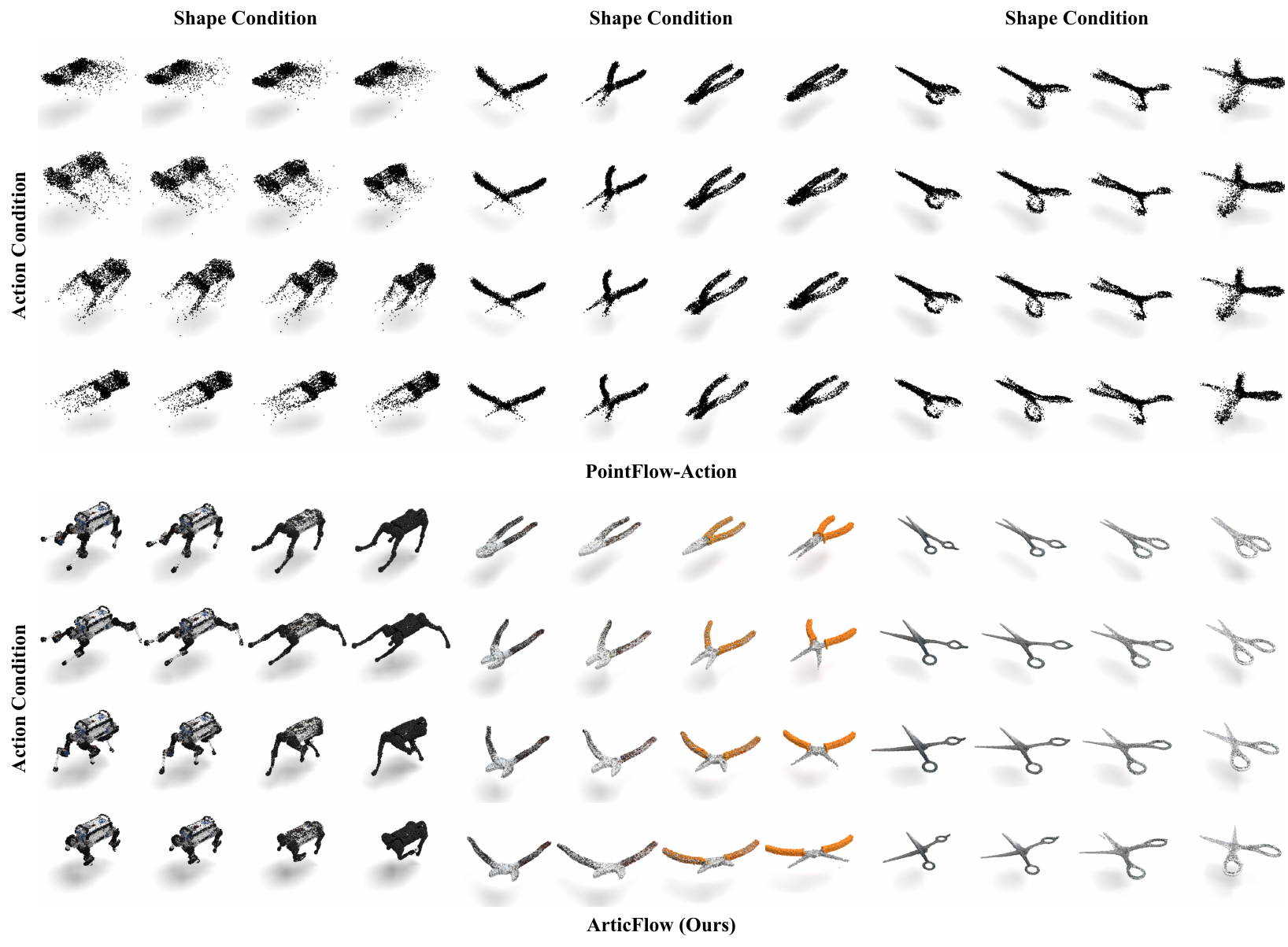
Each frame is an independent sampling of the model conditioned on its action command (shape latent fixed, one action dimension swept) — no point correspondence and no temporal interpolation, exactly as in kinematic simulation. Drag to orbit, scroll to zoom.
A latent flow samples the shape-prior code; the point flow transports noise to the posed shape, conditioned on the action and the shape prior.
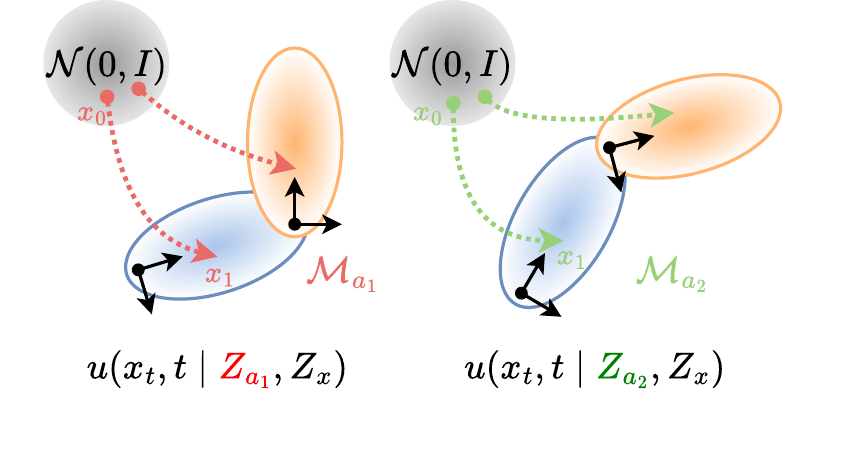
Holding the shape prior fixed produces kinematically consistent deformations of the same instance; holding the action fixed varies appearance under the same pose. Interpolating the shape latent yields novel instances.
@misc{lin2025articflow,
title = {ArticFlow: Generative Simulation of Articulated Mechanisms},
author = {Lin, Jiong and Ruan, Jinchen and Lipson, Hod},
year = {2025},
eprint = {2511.17883},
archivePrefix = {arXiv},
primaryClass = {cs.RO}
}
% CoRL 2026 camera-ready citation: coming soon